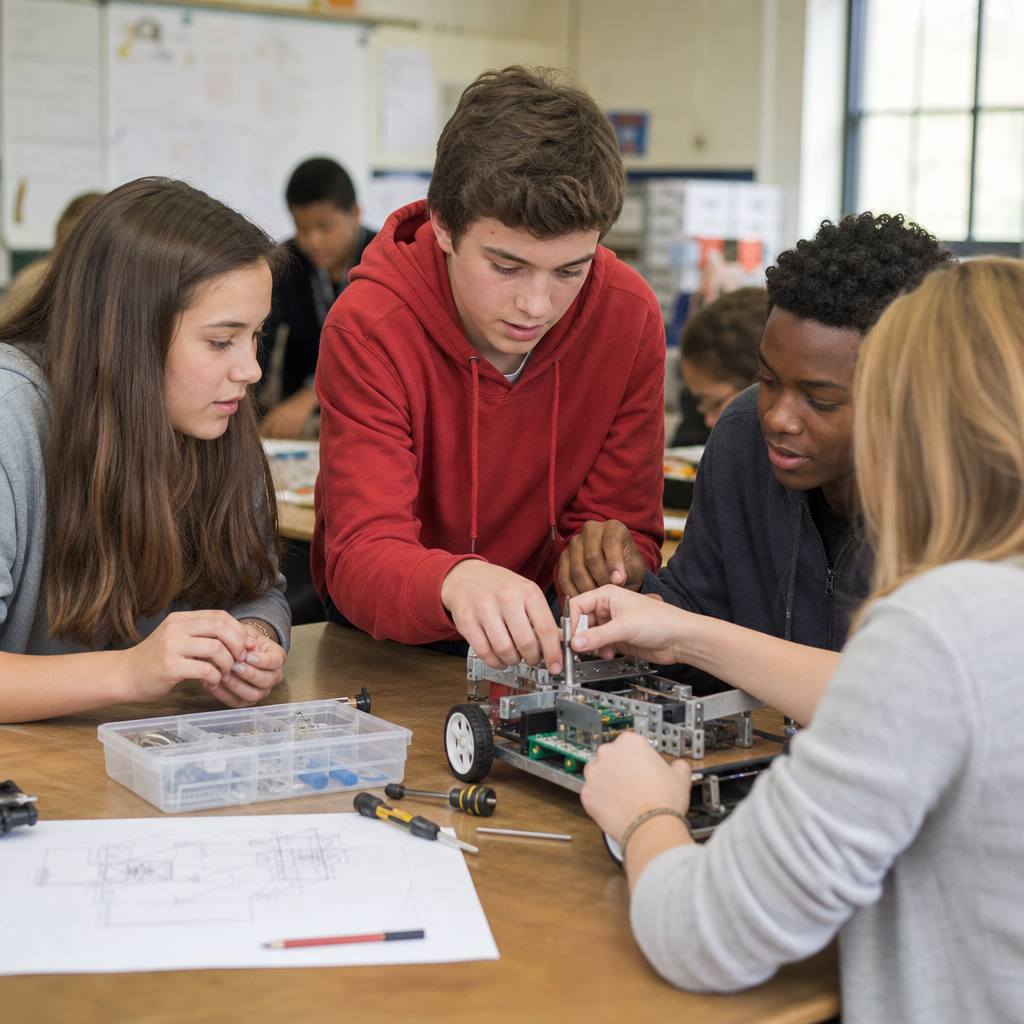
Project-based assessment in the classroom gives teachers a way to measure what students can do with knowledge, not just what they can recall on a test. In practice, it asks learners to investigate a question, design a product, present an argument, solve a problem, or create something useful while teachers evaluate both the process and the final result. That makes it a central part of classroom assessment strategies because it captures application, collaboration, communication, and revision in one coherent task. In K–12 schools and higher education alike, project-based assessment matters because modern standards emphasize transfer, inquiry, and authentic performance. Employers, accrediting bodies, and state frameworks increasingly expect students to analyze information, use evidence, and produce work for real audiences. Traditional quizzes still have a place, but they often reveal only a slice of learning. A well-designed project can show depth of understanding, misconceptions, persistence, and the ability to connect concepts across disciplines.
When I help teachers redesign assessment systems, the first issue is usually not enthusiasm but structure. Many educators like projects, yet they worry about reliability, grading time, uneven group participation, and whether projects are rigorous enough. Those concerns are valid. Project-based assessment is not simply assigning a poster at the end of a unit. It is a planned approach to evidence collection in which learning targets, success criteria, feedback cycles, and scoring tools are aligned from the start. Used well, it becomes the hub for classroom assessment strategies because it naturally integrates formative checks, peer review, self-assessment, conferences, exhibitions, and summative judgments. Used poorly, it becomes ambiguous, subjective, and hard to defend. The difference lies in design, calibration, and transparency.
At its core, project-based assessment combines several key terms. A project is an extended task organized around a meaningful question or challenge. Assessment is the process of gathering evidence and making judgments about student learning. Authentic assessment asks students to perform work that resembles real practice in a discipline or profession. Formative assessment provides feedback during learning so students can improve before final evaluation. Summative assessment judges the level of achievement at the end. Performance criteria describe what quality looks like. Rubrics translate those criteria into observable descriptors. Once teachers understand these building blocks, project-based assessment stops feeling like an add-on and starts functioning as a complete assessment architecture for classrooms, departments, and programs.
What Project-Based Assessment Measures Better Than Traditional Tests
Project-based assessment is especially strong when the learning goal involves transfer, integration, and sustained reasoning. A multiple-choice test can efficiently sample factual knowledge, vocabulary, or discrete skills. It is far less effective at showing whether a student can use those pieces to investigate a local water-quality issue, design an engineering prototype, write a policy brief, or curate a historical exhibit. In those cases, the product matters, but the process matters just as much. Teachers can see how students formulate questions, select sources, test ideas, respond to feedback, and revise. That richer evidence is why project-based assessment is increasingly used in competency-based education, capstone courses, career and technical education, and interdisciplinary programs.
It also reveals habits of mind that are hard to capture on conventional exams. In a science class, for example, students might design an experiment on soil conditions and plant growth. The final report demonstrates content knowledge, but interim checkpoints expose whether students can define variables, control conditions, interpret conflicting data, and explain anomalies. In English language arts, a community oral-history project can assess research, interviewing, synthesis, narrative craft, and source attribution in one sequence. In mathematics, students can model cafeteria waste, analyze trends in spreadsheets, and present cost-saving recommendations to administrators. These tasks produce evidence that is visible, discussable, and often more memorable for students than a single timed assessment window.
Another advantage is student motivation. Learners tend to invest more effort when the task has a real audience, a clear purpose, and some choice in topic or format. That does not mean rigor decreases. In fact, expectations often rise because students must explain decisions and defend claims publicly. A fourth-grade class creating public service announcements about recycling must understand facts well enough to communicate them accurately. A college marketing class developing campaign proposals for a local nonprofit must use audience analysis, budget reasoning, and measurable goals. The authenticity of the task increases accountability. Students know weak work will be obvious when others read, watch, test, or question it.
How to Design Strong Projects and Align Them to Standards
Effective project-based assessment begins with backwards design. Start with the standards, course outcomes, or competencies students must demonstrate. Then identify the evidence that would convincingly show mastery. Only after that should the teacher design the project prompt, timeline, checkpoints, and scoring criteria. This order matters. It prevents attractive but shallow activities that consume time without yielding valid evidence. For example, if a social studies standard requires students to evaluate the credibility of sources and construct an evidence-based argument, the project should require annotated source analysis and a defendable claim, not just a visually appealing display board.
A strong driving question anchors the work. It should be open enough to invite investigation but focused enough to keep the assessment manageable. Questions such as “How should our town reduce stormwater pollution?” or “What can literature teach us about migration and belonging?” create room for inquiry while keeping students tied to disciplinary ideas. The task should specify a product or performance that naturally elicits the target skills: a policy memo, podcast episode, museum panel, lab report, prototype, design brief, or formal presentation. Choice can be built in, but unlimited choice often weakens comparability. I usually recommend choice within bounded options so students have agency without turning grading into guesswork.
Quality criteria must be visible early. Students need exemplars, models, and plain-language explanations of what counts as strong evidence. In teacher teams, I have seen calibration improve dramatically when departments score a few sample projects together before launching a unit. That step uncovers hidden assumptions. One teacher may prioritize creativity; another may value disciplinary accuracy; a third may reward polished visuals. A shared rubric resolves those differences and protects fairness. It also helps students aim their effort wisely. They should know, for instance, whether research quality counts more than presentation polish, and whether collaboration is graded separately from content understanding.
| Design Element | Why It Matters | Classroom Example |
|---|---|---|
| Clear learning targets | Keeps the project tied to standards | Biology students explain ecosystem interactions using evidence |
| Driving question | Frames inquiry and purpose | How can our campus reduce food waste? |
| Checkpoint schedule | Supports progress monitoring | Proposal, research notes, draft, conference, final presentation |
| Analytic rubric | Improves transparency and consistency | Separate scores for evidence, reasoning, communication, and conventions |
| Authentic audience | Raises relevance and accountability | Students present recommendations to school leaders |
Alignment also includes practical constraints. Consider available class time, technology access, reading levels, and support needs. A project is only valid if students have a reasonable chance to demonstrate learning. That may require mini-lessons on citation, data visualization, teamwork protocols, or oral presentation skills. Universal Design for Learning principles are useful here: offer multiple ways to access information, engage with the task, and express understanding while keeping the core criteria constant. In mixed-readiness classrooms, scaffolding should support quality without diluting expectations. Graphic organizers, conferencing, chunked deadlines, and mentor texts all help students reach the same standards through different pathways.
Using Formative Assessment, Rubrics, and Feedback Throughout the Project
The most effective project-based assessment systems gather evidence continuously rather than waiting for the final submission. Formative assessment can include entry tickets, proposal reviews, source checks, notebooks, prototype tests, peer critique, teacher conferences, and reflection logs. Each checkpoint should answer a practical question: Does the student understand the task? Are they using credible evidence? Are misconceptions emerging? Is the group on schedule? These routines reduce last-minute surprises and improve the quality of final products. They also give teachers a defensible record of learning that can support grades, parent communication, and intervention decisions.
Rubrics are essential, but not all rubrics work equally well. Holistic rubrics are faster and useful for quick judgments, yet analytic rubrics are usually better for project-based assessment because they separate dimensions such as content accuracy, reasoning, organization, communication, and technical quality. Students can see where they are strong and where they need revision. Descriptors should be observable and discipline specific. “Uses relevant and credible evidence from multiple sources” is better than “good research.” “Explains limitations of the model and justifies assumptions” is stronger than “shows understanding.” The more concrete the language, the more reliable the scoring.
Feedback should be timely, actionable, and limited to the highest-leverage next steps. Over-commenting overwhelms students and exhausts teachers. I have found that one focused conference can do more than a page of written notes if it addresses a decisive issue, such as whether the claim matches the evidence or whether the prototype actually solves the stated problem. Peer assessment is also valuable when students are trained to use criteria well. Protocols like warm and cool feedback, gallery walks, and structured critique sessions make revision normal rather than punitive. Self-assessment matters too. When students compare their work to the rubric before submission, they become more accurate judges of quality over time.
Grading Fairly, Managing Groups, and Solving Common Challenges
Fair grading is the question teachers ask most often about project-based assessment in the classroom. The solution is to separate what is being measured and avoid letting one strong feature mask a weak one. If the goal is content mastery, grade that directly through the project artifacts, individual reflections, oral defenses, or short companion assessments. If collaboration is important, score it as a separate criterion using observable indicators such as preparation, contribution, responsiveness, and task completion. This distinction prevents the common problem in which a visually impressive project earns a high mark even though the underlying reasoning is weak.
Group work requires especially careful design. Shared products can build teamwork and mirror real professional practice, but individual accountability cannot be assumed. Strong systems assign roles, require individual checkpoints, and collect evidence from multiple sources. A lab team might submit one experiment report, yet each student also completes a methods quiz and a reflection explaining their decisions. In a history documentary project, students can log research contributions, submit individual source annotations, and participate in a brief oral defense. Peer evaluations can help, but they should not carry excessive weight because friendships and conflicts can distort ratings. Teachers need direct evidence as well.
Time management is another challenge. Projects expand to fill available space unless the teacher sets milestones and enforces them. Public deadlines, visible trackers, and short status checks keep momentum steady. Technology can help. Learning management systems like Canvas, Google Classroom, and Schoology make it easier to post rubrics, collect drafts, and document feedback. Collaboration tools such as Google Docs or Microsoft Teams create revision histories that reveal participation patterns. For higher education, platforms like Turnitin support originality checking and feedback distribution. Still, digital tools are only useful when the assessment design is sound. No platform can rescue an unclear prompt or a vague rubric.
Equity should remain central. Students do not enter projects with equal access to background knowledge, materials, or confidence with open-ended tasks. Teachers can reduce inequity by supplying common resources, modeling inquiry processes, and offering structured choices that do not depend on outside money or home support. Culturally responsive project topics also matter. When students examine issues that affect their communities, they often produce stronger analysis and more invested work. At the same time, relevance should not replace rigor. Authenticity and academic challenge belong together.
Where Project-Based Assessment Fits in a Complete Assessment System
Project-based assessment works best as part of a balanced classroom assessment strategy, not as the only method. Teachers still need quick checks for understanding, retrieval practice, discussions, observations, short constructed responses, and occasionally selected-response tests. Each method answers different questions. A quiz may show whether students remember key concepts needed for a project. A project may show whether they can apply those concepts in context. Together, they give a fuller picture of learning. This is why project-based assessment serves well as a hub topic within classroom assessment strategies: it connects formative and summative assessment, academic and applied learning, individual and collaborative performance, and standards-based grading with authentic demonstration.
Programmatically, projects are also useful for vertical alignment. Elementary teachers can begin with tightly scaffolded inquiry and simple products. Middle school classrooms can add research independence, peer critique, and more formal presentation. High school and college courses can move toward discipline-specific methods, public audiences, and complex deliverables such as design portfolios, policy analyses, or capstone exhibitions. Across grade bands, the same principles hold: clarity of purpose, alignment to outcomes, visible criteria, multiple checkpoints, and fair scoring. Schools that implement project-based assessment consistently tend to build stronger shared expectations about what quality work looks like.
Project-based assessment in the classroom is most powerful when it is intentional, evidence driven, and integrated with other classroom assessment strategies. It allows teachers to see learning in action: how students question, research, reason, create, revise, and communicate. It also gives students a more meaningful chance to demonstrate mastery than a single test score can provide. The keys are clear standards alignment, strong rubrics, frequent formative feedback, and systems that protect fairness in grading and group work.
For K–12 and higher education, the main benefit is simple: project-based assessment measures durable understanding and real-world application at the same time. That makes it an essential hub within assessment practice, especially for schools aiming to build critical thinking, collaboration, and transfer across subjects. If you are refining your classroom assessment strategies, start by redesigning one unit around a tightly aligned project, add checkpoints and an analytic rubric, and study the evidence students produce. Done well, one strong project can improve both teaching decisions and student learning.
Frequently Asked Questions
What is project-based assessment in the classroom?
Project-based assessment is a way for teachers to evaluate student learning through meaningful tasks rather than relying only on quizzes or traditional tests. Instead of asking students to simply recall facts, it asks them to apply knowledge in a real or realistic context. Students may investigate a question, design a product, solve a problem, present an argument, conduct research, or create something that demonstrates what they understand and can do. In this model, the assessment is not limited to the final product alone. Teachers also look at how students plan, revise, collaborate, communicate, and make decisions throughout the learning process.
This approach is especially valuable because it captures a wider range of skills than many conventional assessments. A well-designed project can reveal critical thinking, creativity, content mastery, organization, persistence, and the ability to transfer learning to new situations. It also gives students more authentic opportunities to show what they know, which can be especially helpful for learners who do not perform well on timed tests. In the classroom, project-based assessment becomes a practical strategy for measuring deeper understanding while keeping learning active, purposeful, and closely connected to real-world expectations.
How is project-based assessment different from a traditional test?
The biggest difference is that a traditional test usually measures what students can remember at a specific moment, while project-based assessment measures what students can do with what they have learned. A test often focuses on selecting the right answer, defining terms, or recalling information under time pressure. By contrast, a project asks students to use knowledge in context. They may need to analyze evidence, build a solution, create a presentation, support a claim, or respond to feedback over time. This makes project-based assessment a stronger tool for evaluating application, reasoning, and performance.
Another important difference is that project-based assessment is typically more process-oriented. Teachers can observe how students research, organize ideas, collaborate with peers, revise their work, and reflect on challenges. That ongoing visibility gives teachers richer information about student strengths and needs than a single score on a test. Traditional tests still have a place for checking specific knowledge efficiently, but project-based assessment offers a fuller picture of learning by combining content understanding with communication, problem-solving, and sustained effort. In many classrooms, the most effective assessment system includes both, with projects helping teachers measure deeper and more transferable learning outcomes.
What are the benefits of using project-based assessment for students?
Project-based assessment offers several important benefits because it makes learning more active, visible, and relevant. First, it encourages students to move beyond memorization and into higher-level thinking. When students are asked to create, design, investigate, or defend an idea, they must analyze information, make choices, and connect concepts in meaningful ways. This strengthens understanding and often improves retention because students are using knowledge rather than just reviewing it. It also helps learners see why the content matters, especially when projects are tied to real problems, authentic audiences, or practical outcomes.
It also supports the development of essential academic and life skills. Students often practice collaboration, time management, communication, self-direction, revision, and reflection during project work. These are skills that matter in school, college, and the workplace, yet they are not always captured through standard tests. In addition, project-based assessment can increase student engagement because it gives learners more ownership and a clearer sense of purpose. When students understand the goal, know the criteria for success, and have some voice in how they demonstrate learning, they are often more invested in the work. For many classrooms, this leads to stronger participation, deeper learning, and more meaningful evidence of achievement.
How can teachers assess project-based learning fairly and consistently?
Fair and consistent project-based assessment starts with clear expectations. Teachers need to define exactly what students are expected to learn and how that learning will be measured. The most effective way to do this is through a detailed rubric that identifies key criteria such as content accuracy, depth of analysis, creativity, organization, collaboration, presentation quality, and use of evidence. When students receive the rubric at the beginning of the project, they understand the target and can use it to guide their work. Strong rubrics also help teachers reduce subjectivity because they anchor evaluation in specific, observable performance indicators rather than general impressions.
Consistency also improves when teachers assess more than one source of evidence. Instead of grading only the final product, teachers can include checkpoints, drafts, conferences, peer feedback, self-reflection, research notes, and presentations. This provides a more accurate view of student learning and effort over time. It can also help teachers distinguish between individual contribution and group performance in collaborative projects. Calibration is another useful practice. Teachers can review sample student work, compare scoring decisions, and align expectations across classrooms or grade levels. With clear criteria, multiple forms of evidence, and ongoing feedback throughout the process, project-based assessment can be both rigorous and equitable.
What makes a strong project-based assessment in the classroom?
A strong project-based assessment is aligned to learning goals, rooted in a meaningful task, and structured so students can demonstrate deep understanding. The project should begin with a clear purpose or driving question that invites inquiry and application. It should require students to use important content knowledge, not just complete an activity. In other words, the project must assess what matters most in the curriculum. A strong assessment also includes an authentic product or performance, such as a presentation, report, model, proposal, experiment, or solution, so students can show how they apply learning in a concrete way.
Equally important, strong project-based assessment includes support and accountability throughout the process. Students need milestones, feedback opportunities, and clear success criteria so the project remains academically focused and manageable. Teachers should design the assessment so that both process and final outcome are visible, allowing evaluation of planning, revision, communication, and problem-solving along the way. Reflection is another hallmark of quality. When students explain their choices, identify what they learned, and consider how they improved, teachers gain valuable insight into understanding and growth. Taken together, these elements create an assessment that is engaging for students, useful for teachers, and far more revealing than a single score from a traditional classroom test.