
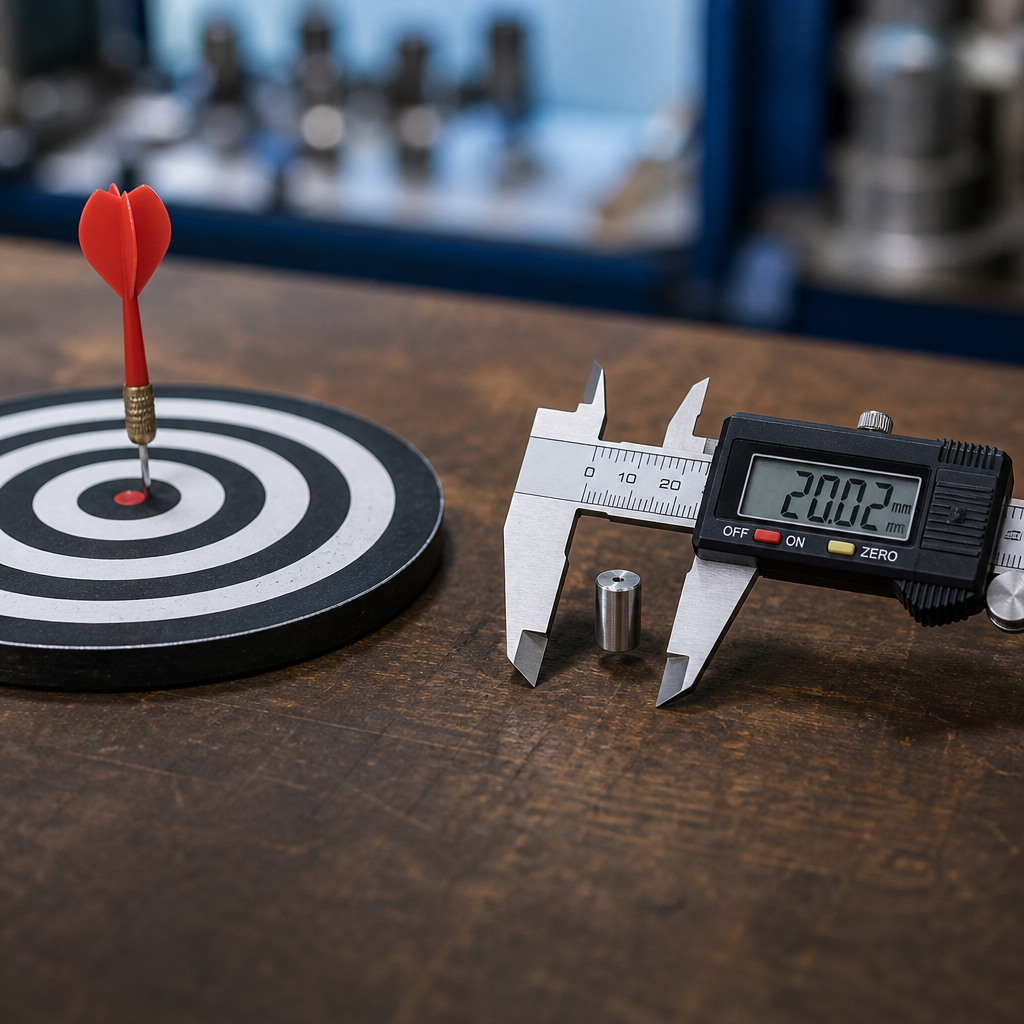
Bias and measurement error are often treated as interchangeable problems, but in psychometrics they describe different threats to score quality, test interpretation, and decision making. Measurement error is the gap between an observed score and a person’s theoretical true score, while bias refers to systematic distortion that unfairly advantages or disadvantages groups, items, raters, or methods. The distinction matters because a test can be highly reliable yet still biased, or broadly unbiased yet too noisy to support precise decisions. I have seen teams misdiagnose score problems by calling every bad result “bias,” when the real issue was unstable administration, poor item targeting, inconsistent raters, or weak scaling. Clear language leads to better diagnosis.
Within psychometrics and measurement theory, measurement error is the broader hub topic because it includes random error, systematic error, standard error of measurement, reliability, conditional precision, rater inconsistency, mode effects, and score uncertainty over time. Bias sits partly inside that landscape, but it is not the whole map. If you are building, selecting, validating, or auditing an assessment, you need to know whether a score problem comes from imprecision, invalid construct representation, or inequitable functioning. That difference changes what you fix, how you report results, and whether a score should be used at all.
At a practical level, the consequences are large. In education, a small amount of score error near a cut score can change placement or graduation outcomes. In hiring, interviewer severity and structured scoring can influence candidate rankings more than true differences in ability. In health measurement, instrument calibration drift can obscure treatment effects. In survey research, careless responding and wording effects can inflate noise, while differential item functioning can create biased comparisons between groups. The key question is not simply whether a measure “works,” but how much uncertainty surrounds each score and whether that uncertainty is random, systematic, or group linked.
This article explains bias versus measurement error in plain terms while covering measurement error comprehensively as a subtopic hub. It defines the concepts, shows how they appear in classical test theory and item response theory, explains common sources, and outlines how psychometricians detect and reduce them. If you need a direct answer, here it is: measurement error concerns precision, bias concerns distortion, and high-quality measurement requires controlling both. The rest of the article unpacks that statement with the concepts, methods, and examples used in real assessment work.
What measurement error means in psychometrics
Measurement error is the difference between the observed score and the true score that would be obtained under ideal repeated measurement of the same construct. In classical test theory, the standard expression is X = T + E, where X is the observed score, T is true score, and E is error. Error is not a moral failing or a mistake by one person; it is an expected feature of all measurement. A student’s score changes because of fatigue, guessing, ambiguous items, timing, distractions, or scoring inconsistency. A patient’s reported pain changes because of mood, context, wording, and recall limits. The central psychometric task is to estimate how much these factors affect scores.
Measurement error can be random or systematic. Random error introduces unpredictable fluctuation around the true score, lowering reliability and widening uncertainty intervals. Systematic error shifts scores in a patterned way, such as when one form is harder than another or a rater is consistently severe. Some systematic error is classified as bias when it creates construct-irrelevant advantage or disadvantage, especially across groups. Other systematic error is not necessarily bias in the fairness sense, but it still damages interpretation. This is why measurement error is the larger umbrella concept for this topic cluster.
A core quantity is the standard error of measurement, usually written as SEM. Under classical assumptions, SEM can be estimated as SD × √(1 − reliability). If a test has a standard deviation of 15 and reliability of .84, the SEM is 15 × √.16 = 6. That means an observed score of 100 implies a true-score band around 94 to 106 for roughly one SEM, assuming model fit and stable conditions. In practice, I advise teams not to report single scores without discussing uncertainty when decisions depend on small differences.
Precision is not constant in every model. In item response theory, conditional standard error varies across the score scale. A reading test may measure average ability precisely while becoming much less precise at the very low or very high ends because there are too few well-targeted items. This matters for screening and selection. If the cut score sits where information is weak, error rises exactly where the decision is most sensitive. The best psychometric reports show where measurement is strongest, not just one overall reliability coefficient.
How bias differs from measurement error
Bias is a systematic departure from accurate measurement that distorts scores, interpretations, or decisions. In psychometrics, bias often means construct-irrelevant variance tied to group membership, test content, response process, administration mode, language background, disability access, or rater expectations. A test can contain biased items even when total score reliability looks strong. That is why reliability is necessary but not sufficient for validity. Reliable mismeasurement is still mismeasurement.
The cleanest distinction is this: measurement error asks, “How precise is the score?” Bias asks, “Is the score systematically off in a particular direction or for a particular group?” Random error makes scores unstable. Bias makes them unfair or inaccurate in a patterned way. Imagine a bathroom scale. If it fluctuates between 148 and 152 for the same person, that is imprecision. If it always reads 5 pounds high, that is systematic error. If it reads high only for heavier users because of a design flaw, that resembles bias with subgroup impact.
In testing, differential item functioning is one of the most widely used tools for identifying potential item bias. An item shows DIF when examinees from different groups but with the same underlying ability have different probabilities of answering correctly. For example, a math word problem using culture-specific sports terminology may disadvantage some students for reasons unrelated to math skill. DIF does not automatically prove harmful bias, because content relevance and impact need substantive review, but it is a strong diagnostic signal.
Bias can also occur through administration and scoring. I have audited performance assessments where one site gave examinees extra clarification, while another followed the script strictly. The resulting score differences looked like group gaps until administration logs revealed the issue. In essay scoring, halo effects, central tendency, and leniency-severity patterns create systematic distortion unless raters are calibrated and monitored. In surveys, acquiescence and extreme responding can vary across cultures, creating biased group comparisons when scales are not designed or modeled appropriately.
Major sources of measurement error
Measurement error comes from multiple sources, and good quality control requires separating them. Common sources include item sampling, transient person factors, administration conditions, scoring inconsistency, instrument malfunction, translation issues, and data processing mistakes. In generalizability theory, these are treated as facets such as items, raters, occasions, and tasks. That framework is useful because it shows that one reliability coefficient can hide several distinct error sources, each requiring a different intervention.
Item sampling error arises because a test uses a limited sample of possible items from a domain. A 20-item algebra quiz cannot cover every algebra skill equally well, so observed scores vary depending on which items were selected. Longer tests usually reduce this error, although badly written extra items can add noise rather than precision. Person-related error includes fatigue, anxiety, motivation, illness, and practice effects. These factors matter most when the construct itself is sensitive to state variation, as in mood, pain, or attention measures.
Administration error includes timing differences, room noise, internet instability in online testing, device effects, and inconsistent instructions. During remote assessments, I have seen lag, screen-size differences, and browser incompatibilities change item presentation enough to alter performance. Scoring error appears in hand scoring, rubric interpretation, and automated scoring systems trained on unrepresentative samples. Data handling error can enter through miscoding, reverse-scored items left unreversed, merging mistakes, or calibration drift after software updates.
| Source | Typical effect | Example | Common remedy |
|---|---|---|---|
| Item sampling | Unstable total scores | Short domain test misses key skills | Add high-quality items, blueprint carefully |
| Rater inconsistency | Severity or leniency shifts | Essay raters score the same script differently | Calibration, many-facet Rasch, monitoring |
| Administration conditions | Mode or setting effects | Remote test takers lose time after disconnections | Standardization, logs, equivalence studies |
| Transient person factors | Within-person fluctuation | Fatigue lowers end-of-day performance | Retesting rules, scheduling controls |
| Data processing | Artificial score distortion | Reverse-coded items scored incorrectly | Audit trails, validation checks |
How psychometricians estimate and report error
The most common entry point is reliability, but reliability is only an indirect summary of error. Internal consistency indices such as coefficient alpha and omega estimate how consistently items relate, though alpha assumes essentially tau-equivalent items and is often overinterpreted. Test-retest reliability captures temporal stability. Inter-rater reliability assesses scoring agreement. Parallel forms reliability addresses form consistency. Each coefficient answers a different question, so using the wrong one can hide the real error problem.
SEM translates reliability into score-level uncertainty, which makes results easier to interpret for practitioners. Confidence intervals around scores are better than raw point estimates, especially near decision thresholds. For classification decisions, psychometricians also examine decision consistency and decision accuracy. A cut score may look defensible on average yet produce unacceptable classification error for examinees near the threshold. In credentialing and admissions, this is a major governance issue, not a technical footnote.
Item response theory adds stronger tools when model assumptions are met. The item information function and test information function show where precision is highest across the latent trait. This is one reason adaptive testing can outperform fixed forms: it selects items targeted to an examinee’s estimated level, often reducing error with fewer items. Rasch models, two-parameter logistic models, graded response models, and partial credit models each provide different ways to estimate latent traits and standard errors, depending on item type and construct assumptions.
For more complex designs, generalizability theory decomposes variance into multiple sources, such as persons, items, raters, and occasions. A G study estimates variance components; a D study forecasts how changing the number of items or raters would alter reliability. In performance assessment, this is invaluable. I have used G theory to show that adding one trained rater improved dependability more than adding two new tasks, saving money while increasing score quality. The best error analysis supports operational decisions, not just technical appendices.
Detecting bias and separating it from noise
Separating bias from ordinary measurement error requires both statistics and substantive review. A group mean difference alone does not prove bias, because groups can differ on the construct being measured. Likewise, an item with low discrimination is not automatically biased; it may simply be poorly written. Strong practice combines quantitative screening, content review, response process evidence, and validation against external criteria.
DIF analysis is standard for item-level group comparisons. Methods include Mantel-Haenszel, logistic regression DIF, and IRT-based likelihood ratio approaches. For rating contexts, many-facet Rasch measurement can estimate candidate ability, task difficulty, and rater severity on the same scale, making systematic rater effects visible. Measurement invariance testing in confirmatory factor analysis evaluates whether a scale functions similarly across groups at configural, metric, and scalar levels. Without at least approximate invariance, comparing latent means is risky.
Response process evidence is equally important. Cognitive interviews reveal whether test takers interpret items as intended. Think-aloud protocols can show that an item designed to measure scientific reasoning actually depends on advanced reading comprehension. In multilingual settings, translation and adaptation should follow recognized procedures such as forward translation, back translation, expert review, and pilot testing, consistent with International Test Commission guidance. Bias reduction is strongest when fairness is built during design rather than patched in after score release.
Reducing measurement error in real assessment programs
The most effective way to reduce measurement error is to design for it from the beginning. Start with a clear construct definition and test blueprint. Align items to content and cognitive process targets. Write more items than you need, then pilot them, analyze difficulty and discrimination, and remove weak performers. Standardize administration scripts, timing, and technology requirements. Train raters with benchmark responses and monitor drift throughout scoring. Build audit checks into scoring and data pipelines so preventable processing errors never reach reports.
Use the right model for the score use. For low-stakes classroom quizzes, simple reliability checks and item analysis may be enough. For licensure, admissions, or diagnosis, stronger evidence is required: equating, conditional SEM, fairness analysis, and documented standard-setting procedures. The Standards for Educational and Psychological Testing provide the benchmark framework here. They do not eliminate judgment, but they make clear that technical quality, fairness, and intended use must be evaluated together.
Ongoing monitoring matters because error structures change. Item exposure affects adaptive banks. Remote proctoring policies alter behavior. New populations can break assumptions established in pilot samples. Automated scoring systems can drift when prompt features shift. I recommend annual technical reviews at minimum, with trigger-based reviews whenever mode, population, content blueprint, or scoring method changes materially. Measurement error is not a one-time validation box; it is an operational risk that needs continuous control.
Why the distinction improves decisions
When organizations understand bias versus measurement error, they stop applying one fix to every score problem. If the issue is random error, the solution may be more items, better targeting, or repeated measurement. If the issue is bias, the remedy may be item revision, accessibility redesign, rater retraining, translation improvement, or even withdrawal of a score use that cannot be defended. That distinction protects examinees and improves decision quality.
The main takeaway is simple. Measurement error concerns uncertainty in scores; bias concerns systematic distortion in scores. Both reduce validity, but they do so in different ways and call for different evidence. As you build out your broader work in psychometrics and measurement theory, treat measurement error as the hub: reliability, SEM, conditional precision, rater effects, administration effects, invariance, and fairness all connect here. Review your current instruments, identify where uncertainty enters, and document how you will measure, report, and reduce it.
Frequently Asked Questions
1. What is the difference between bias and measurement error in psychometrics?
Bias and measurement error are related concepts, but they are not the same problem. Measurement error refers to the difference between a person’s observed score and their theoretical true score. In other words, it is the random or unwanted fluctuation that makes a score less precise than it would be in a perfect measurement system. This can happen because of temporary factors such as fatigue, distractions, guessing, inconsistent scoring, or poorly functioning items. The central issue with measurement error is imprecision: the score may vary from occasion to occasion even when the underlying trait has not truly changed.
Bias, by contrast, is a systematic distortion in measurement or interpretation. Rather than introducing random noise, bias pushes results in a particular direction and can unfairly advantage or disadvantage certain individuals or groups. Bias can emerge from item wording, cultural assumptions, administration conditions, rating practices, translation issues, or differences in how groups interact with a test despite having the same underlying ability or trait level. The central issue with bias is fairness and validity: the test may consistently misrepresent what it claims to measure for some people.
A useful way to think about the distinction is that measurement error threatens precision, while bias threatens accuracy and fairness. A test score can be unreliable because it contains too much random error, or it can be consistently produced and still be biased. That is why psychometricians treat these as separate threats to score quality. Understanding the difference helps researchers and decision makers choose the right remedies, whether that means improving reliability, revising problematic items, retraining raters, or checking for differential performance across groups.
2. Can a test be reliable but still biased?
Yes, absolutely. This is one of the most important ideas in psychometrics because reliability and bias address different qualities of a test. Reliability tells you whether scores are consistent. If people took the same test under similar conditions, or if different items measuring the same construct produce similar results, a reliable test will tend to yield stable patterns. But consistency alone does not guarantee that the test is fair or valid for all examinees.
A test can be highly reliable and still biased if it consistently measures something in a way that favors one group over another. For example, imagine a reading assessment that includes culturally specific references unfamiliar to some examinees. If those items consistently disadvantage one group, the test may still show strong internal consistency and test-retest stability, yet the resulting scores would reflect systematic distortion rather than only the intended construct. In that case, the test is reliably producing scores, but the scores are not equally meaningful or fair across groups.
This is why psychometric evaluation cannot stop at reliability coefficients. A high alpha, omega, or test-retest correlation does not prove the absence of bias. Researchers also need evidence about construct validity, item functioning, invariance across groups, and fairness in interpretation and use. In practical settings such as admissions, hiring, certification, and clinical assessment, this distinction is critical. A dependable instrument that systematically misrepresents certain examinees can lead to confident but unfair decisions, which is often more dangerous than obvious unreliability.
3. Is measurement error always random, while bias is always systematic?
In classical psychometric language, measurement error is typically treated as random variation around a true score, while bias is treated as systematic distortion. That basic contrast is helpful and widely used, especially when introducing the concepts. Random error reduces precision because it causes observed scores to fluctuate unpredictably. Bias reduces validity because it shifts scores or interpretations in a patterned way. So as a first principle, yes: measurement error is generally discussed as random, and bias as systematic.
However, real-world assessment is often more complicated. Some sources of error can show patterns, and some systematic influences may be modeled separately depending on the measurement framework being used. For example, rater severity in performance assessments may introduce a systematic scoring tendency. In one sense, that is a source of measurement error because it pulls observed scores away from the intended construct estimate. In another sense, if the severity systematically affects certain groups or certain response styles more than others, it also raises bias concerns. Similarly, poor testing conditions can increase score variability for everyone, but if those conditions disproportionately affect one subgroup, the issue moves beyond simple random error.
The practical takeaway is that psychometricians distinguish these concepts because they call for different questions. If scores are unstable, the question is how much unintended variability is present and how to reduce it. If scores are unfairly shifted for some examinees, the question is whether the instrument or process is biased. Even when the boundaries blur in complex assessments, keeping the random-versus-systematic distinction in mind remains useful for diagnosis, analysis, and corrective action.
4. How do psychometricians detect bias versus measurement error?
Psychometricians use different tools because bias and measurement error reveal themselves in different ways. Measurement error is often evaluated through reliability evidence and precision estimates. Common methods include internal consistency statistics, test-retest reliability, parallel-forms reliability, inter-rater agreement, and standard error of measurement. These analyses help determine whether scores are stable and precise enough for their intended use. If reliability is weak or the standard error is large, then observed scores may not reflect a person’s true standing with enough confidence.
Bias requires a different set of analyses focused on fairness, comparability, and construct representation. At the item level, psychometricians may examine differential item functioning to see whether individuals from different groups with the same underlying trait level have different probabilities of answering an item correctly or endorsing it similarly. At the test level, they may investigate measurement invariance to determine whether the construct is being measured in the same way across groups. In performance or observational assessments, they may study rater effects, subgroup score patterns, administration differences, or content reviews for cultural and linguistic appropriateness.
Qualitative review also matters. Expert panels can examine whether items contain biased assumptions, loaded language, inaccessible formats, or construct-irrelevant barriers. Statistical evidence alone may not fully explain why a problem exists, so psychometric practice often combines quantitative methods with substantive judgment. The goal is not only to flag anomalies, but to determine whether score differences reflect genuine differences in the construct or flaws in the measurement process. That distinction is essential for valid interpretation and defensible decision making.
5. Why does the distinction between bias and measurement error matter in real testing decisions?
The distinction matters because the consequences of each problem are different, and so are the solutions. If a test suffers mainly from measurement error, the concern is that decisions may be based on scores that are too noisy or unstable. Someone might score a little higher or lower simply because of chance fluctuations, ambiguous items, temporary distractions, or inconsistent scoring. In those cases, the remedy might include lengthening the test, improving item quality, standardizing administration, or enhancing scorer training. The focus is on increasing precision so that observed scores better approximate true scores.
If a test is biased, the problem is more serious from a fairness and ethical standpoint because the measurement process may systematically disadvantage particular people or groups. A biased test can create unequal opportunities, distort classification decisions, and undermine trust in the assessment system even if the scores look highly consistent. In educational, employment, clinical, and licensure contexts, this can lead to inappropriate placement, missed diagnoses, unfair selection outcomes, or invalid policy conclusions. The remedy is not just more precision; it may require revising or removing items, changing procedures, redesigning scoring systems, or rethinking how scores are interpreted and used.
Most importantly, confusing bias with measurement error can lead organizations to solve the wrong problem. A team might celebrate high reliability and assume the assessment is sound, while overlooking subgroup unfairness. Or they might attribute score differences to bias when the larger issue is simply low precision. Good psychometric practice separates these threats so that each can be investigated directly. That leads to stronger tests, more defensible interpretations, and decisions that are not only technically sound but also fair and responsible.