
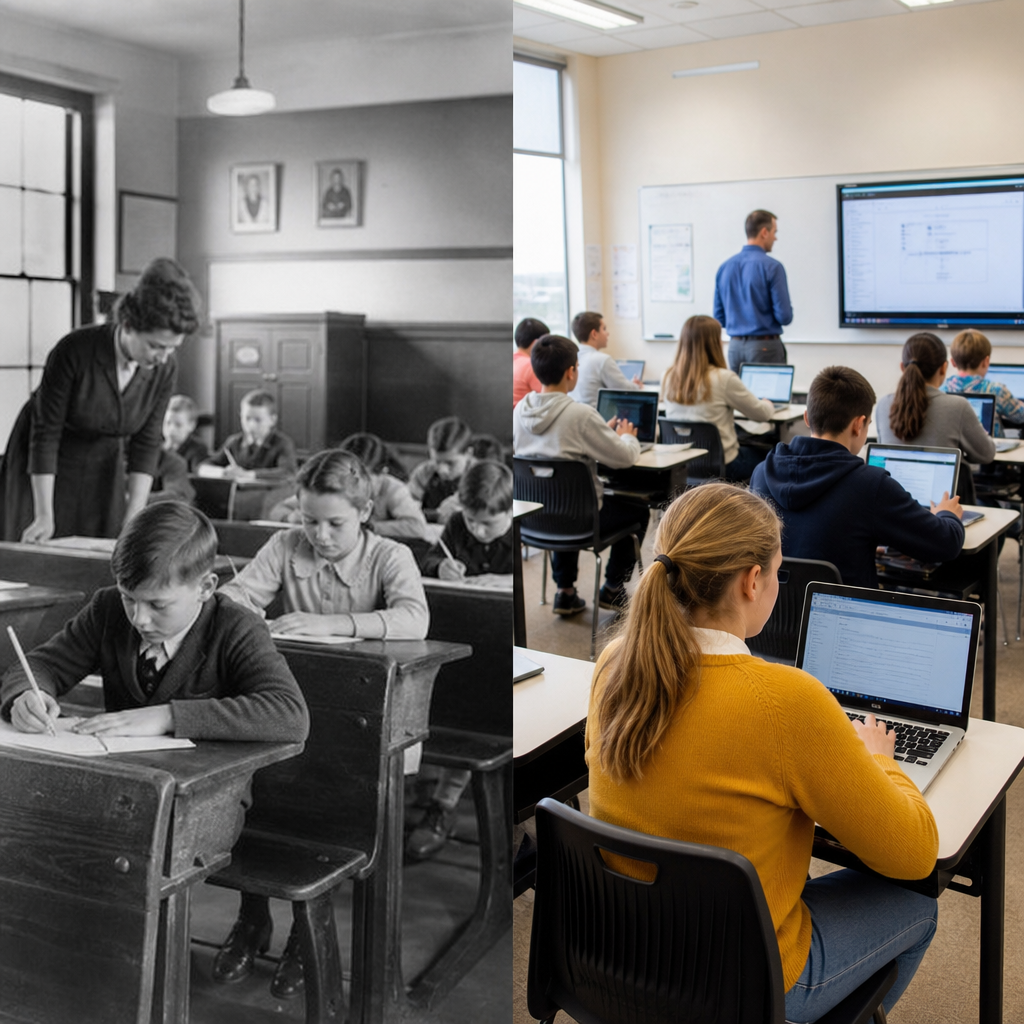
Educational assessment is the systematic process of gathering evidence about what learners know, can do, and need next, then using that evidence to improve teaching, certify achievement, and guide decisions. In practice, assessment includes classroom questioning, quizzes, essays, performance tasks, portfolios, standardized tests, observations, and data reviews. As someone who has designed rubrics, audited test blueprints, and sat with teachers after disappointing score reports, I have seen the same truth repeatedly: assessment is never just about measurement. It shapes curriculum, influences motivation, determines access to opportunities, and signals what a school system truly values.
The evolution of educational assessment matters because modern schools are asked to do several things at once. They must support learning, compare results across classrooms, ensure fairness, satisfy accountability requirements, and prepare students for complex real-world work. Those demands have pushed assessment from informal oral recitation toward more structured, evidence-based approaches. Understanding that shift helps educators choose better methods today. It also helps parents, school leaders, and policymakers distinguish between useful assessment and testing that creates noise without insight. This hub article explains what educational assessment is, how it developed, the main types used now, and the principles that make assessment valid, reliable, fair, and actionable.
What Educational Assessment Means and Why It Exists
Educational assessment is broader than testing. A test is one tool; assessment is the full decision-making cycle. It starts with a learning goal, such as interpreting primary sources, solving linear equations, or conducting a lab investigation. Then educators collect evidence through selected methods, interpret that evidence against criteria or standards, and decide what to do next. Those decisions may include reteaching a concept, assigning enrichment, grading performance, identifying support needs, or evaluating a program. If no decision follows, the activity generated data but not meaningful assessment.
Assessment exists for three core purposes. First, it supports learning by revealing misconceptions and progress during instruction. Second, it certifies attainment by documenting whether students met defined expectations at a point in time. Third, it informs systems by providing information for placement, accountability, curriculum review, and resource allocation. These purposes often overlap, but problems arise when one instrument is forced to serve all of them equally well. A high-stakes accountability exam, for example, may offer useful trend data but weak day-to-day guidance for a teacher planning tomorrow’s lesson.
Clear terminology helps. Measurement refers to assigning numbers to performance. Evaluation goes further by making judgments about quality or value. Assessment sits between them, combining evidence collection with interpretation. Good assessment also depends on constructs, the underlying abilities or knowledge being inferred. Reading comprehension, scientific reasoning, and oral fluency are constructs. If the task format measures handwriting speed more than historical understanding, the intended construct has been distorted. That issue, known as construct-irrelevant variance, remains one of the most important concerns in modern assessment design.
How Assessment Evolved from Oral Traditions to Standardized Testing
Early educational assessment was largely oral, local, and immediate. In many ancient and medieval settings, students demonstrated learning through recitation, disputation, memorization, and direct performance before a teacher. These methods could be rigorous, but they depended heavily on the examiner’s judgment and were difficult to scale. As mass schooling expanded in the nineteenth century, systems needed more uniform methods to compare students and manage progression. Written examinations became more common because they created a lasting record and allowed larger groups to be assessed under similar conditions.
The rise of psychometrics in the late nineteenth and early twentieth centuries transformed assessment further. Researchers such as Alfred Binet helped establish systematic testing approaches, while later developments in classical test theory introduced concepts like reliability coefficients, item difficulty, and score distributions. In the United States and many other countries, standardized tests grew quickly alongside compulsory schooling, university admissions, military classification, and civil service selection. These instruments promised consistency and comparability, advantages that local teacher judgments alone could not always provide.
Yet standardization brought tradeoffs. Large-scale tests often emphasized selected-response formats because they were efficient and machine scorable. That improved consistency but narrowed the range of performances measured well. Writing quality, problem-solving processes, collaboration, and creativity proved harder to capture. By the late twentieth century, reform movements pushed for authentic assessment, performance assessment, and standards-based systems that aligned evidence more closely to ambitious learning goals. Today’s landscape reflects that history: schools still use standardized tests, but they increasingly combine them with classroom-based evidence, digital tools, and performance tasks to create a more complete picture of learning.
Major Types of Educational Assessment Used Today
Current practice usually groups educational assessment into four major types: diagnostic, formative, summative, and interim or benchmark. Diagnostic assessment occurs before instruction or at the start of a unit. Its purpose is to identify prior knowledge, misconceptions, language needs, and prerequisite skills. A mathematics teacher might use a short pre-assessment on fractions before beginning algebraic ratios. If half the class confuses numerator and denominator, the teacher can address that barrier before new content collapses under missing foundations.
Formative assessment happens during learning and is designed to improve it. Effective examples include hinge questions, exit tickets, low-stakes quizzes, peer review guided by criteria, think-alouds, and targeted conferencing. The key feature is not the format but the feedback loop. When evidence leads to immediate adjustment by the teacher or student, the assessment is functioning formatively. Research associated with Paul Black and Dylan Wiliam has shown that well-implemented formative assessment can produce substantial gains, especially for lower-achieving students, because it makes learning visible while there is still time to respond.
Summative assessment evaluates learning after a defined period, such as the end of a unit, semester, or course. Final exams, capstone projects, practical demonstrations, and end-of-course tests are familiar examples. Interim assessments sit between classroom checks and annual exams. Districts often use them every six to eight weeks to monitor progress toward standards. Each type has value when matched to purpose. Trouble starts when schools treat all assessments as summative or mistake frequent testing for useful evidence. The best systems coordinate these types rather than letting them compete.
| Assessment type | Main purpose | Typical timing | Example |
|---|---|---|---|
| Diagnostic | Identify starting points and misconceptions | Before instruction | Pre-unit reading inventory |
| Formative | Guide immediate teaching and learning adjustments | During instruction | Exit ticket on key concept |
| Interim | Monitor progress toward standards across classes | Periodic, often every 6–8 weeks | District benchmark assessment |
| Summative | Judge achievement at the end of learning | After instruction | Final exam or performance project |
Principles of High-Quality Assessment: Validity, Reliability, Fairness, and Alignment
When educators ask what makes an assessment good, four principles should anchor the answer. First is validity: does the evidence support the intended interpretation and use of scores? Validity is not a property stamped permanently onto a test. It depends on context, purpose, content coverage, response processes, and consequences. A timed multiple-choice test may be valid for sampling factual recall but weak for evaluating sustained argument writing. The Standards for Educational and Psychological Testing emphasize collecting multiple sources of validity evidence, not relying on assumptions.
Second is reliability, the consistency of results. Reliability matters because unstable scores lead to poor decisions. In classrooms, reliability improves when teachers use clear rubrics, common scoring guides, anchor papers, and moderation practices. On large-scale assessments, reliability is estimated statistically through methods such as internal consistency, test-retest, or inter-rater agreement. Third is fairness. Fair assessment avoids unnecessary barriers related to language, disability, culture, or socioeconomic context. Universal Design for Learning principles, accessibility supports, and bias review committees all help reduce construct-irrelevant obstacles without lowering standards.
Fourth is alignment. Assessment should match learning targets, instructional emphasis, and cognitive demand. I have reviewed many assessments that claimed to measure critical thinking yet only asked students to recall definitions. That mismatch undermines both teaching and trust. High-quality assessment also requires transparency: students should understand the criteria for success, the purpose of the task, and how results will be used. Without that clarity, even technically strong instruments can feel arbitrary and disengaging. Quality, then, is not about test length or difficulty. It is about fit between purpose, evidence, interpretation, and action.
Classroom Assessment, Feedback, and the Shift Toward Learning-Centered Practice
The most important changes in educational assessment over the past several decades have happened inside classrooms. Instead of viewing assessment as an event after teaching, many schools now integrate it into instruction itself. Learning intentions and success criteria are shared up front. Students examine exemplars, use rubrics during drafting, and respond to feedback before a grade is final. This shift reflects a practical insight: when assessment happens only at the end, it records failure or success but cannot improve either. When it happens during learning, it becomes one of the strongest drivers of achievement.
Feedback is the mechanism that makes classroom assessment effective. Strong feedback is specific, timely, and focused on the task or process rather than the student’s identity. “Your claim is clear, but the evidence does not yet address the counterargument” is useful. “Good job” is not. John Hattie’s synthesis of educational research has repeatedly highlighted feedback as a high-impact influence when it reduces the gap between current and desired performance. The best teachers also build student self-assessment and metacognition. Checklists, reflection prompts, and conferencing help learners judge their own work against standards.
Learning-centered assessment does not mean abandoning grades or rigor. It means sequencing evidence intelligently. For example, a science teacher might begin with a diagnostic probe on ecosystems, use mini whiteboard checks during instruction, assign a lab report with rubric-based peer review, and end with a summative investigation. Each step serves a different purpose while staying aligned to the same standards. Schools that adopt this approach usually see a secondary benefit: assessment anxiety decreases because students experience evaluation as guidance, not only judgment.
Digital Assessment, Data Use, and the Future of Educational Assessment
Technology has expanded what educational assessment can capture and how quickly evidence can be used. Online platforms such as Google Forms, Canvas, Moodle, and Microsoft Forms allow rapid checks for understanding and instant item analysis. Adaptive assessment systems adjust question difficulty based on student responses, producing more precise estimates of ability across a wider range of performance. Large testing programs increasingly use item response theory to calibrate items and support comparability across forms. In performance-rich fields, digital portfolios now preserve drafts, reflections, media artifacts, and longitudinal evidence far better than paper folders ever could.
Data dashboards have also changed practice, though not always for the better. Good dashboards help teachers identify trends, subgroup patterns, and standard-level strengths or gaps. Poor dashboards flood schools with numbers disconnected from instructional decisions. I have watched teams spend hours color-coding benchmark reports without once reviewing actual student work, which is where the most actionable evidence often lives. Effective data use combines quantitative patterns with qualitative artifacts such as writing samples, oral explanations, and observational notes. Numbers indicate where to look; student work shows why performance looks the way it does.
Looking ahead, the future of educational assessment will likely blend stronger classroom evidence, more sophisticated digital measurement, and increasing concern for ethics. Artificial intelligence can assist with scoring, item generation, and personalized feedback, but it raises questions about bias, transparency, privacy, and over-automation. Performance assessment will continue to grow because employers and universities value application, not just recall. At the same time, standardized measures will remain necessary for system-level comparability. The challenge is not choosing one approach forever. It is building coherent assessment systems that honor human judgment, technical quality, and the full complexity of learning.
The evolution of educational assessment shows a clear pattern: each era tries to solve the limits of the one before it. Oral examinations offered immediacy but little scalability. Standardized tests brought comparability but often narrowed what counted as achievement. Contemporary assessment seeks a better balance by combining technical rigor with richer evidence of learning. For anyone asking what educational assessment is, the most accurate answer is this: it is the disciplined use of evidence to support learning, judge attainment, and improve educational decisions at every level.
The strongest assessment systems are purposeful, not excessive. They use diagnostic tools to establish starting points, formative processes to guide instruction, summative tasks to certify learning, and interim measures only when those results inform action. They are grounded in validity, reliability, fairness, and alignment. They also recognize that no single score can represent everything that matters. Essays, discussions, projects, observations, and tests each reveal different dimensions of competence. When combined thoughtfully, they produce a more trustworthy picture than any one method alone.
If you are building your understanding of the foundations of educational assessment, start by auditing the assessments you already use. Ask what decision each one supports, what construct it measures, whether students understand the criteria, and what action follows the evidence. That simple review will reveal gaps faster than any slogan about better testing. From there, explore the connected topics in this hub, including formative assessment, summative assessment, validity, reliability, rubrics, standardized testing, and performance assessment, so your system measures what matters and improves what students actually learn.
Frequently Asked Questions
What is educational assessment, and how has its purpose changed over time?
Educational assessment is the structured process of collecting evidence about what students know, understand, can do, and are ready to learn next. At its core, assessment is not just about assigning grades or producing test scores. It is about informing instruction, monitoring progress, identifying strengths and gaps, certifying achievement, and supporting better decisions for students, teachers, schools, and systems. Historically, assessment was often narrow in scope. In many earlier models of schooling, it centered heavily on recitation, oral examination, memorization, and later on written tests designed to rank students or determine whether they had mastered prescribed content. The emphasis was frequently on sorting and selection rather than on improvement.
Over time, the purpose of assessment expanded. As education systems grew more complex and expectations for student learning changed, assessment began to serve additional roles. Teachers increasingly used classroom evidence to adjust lessons in real time. Schools used assessment results to evaluate curriculum alignment and instructional effectiveness. Policymakers relied on larger-scale assessments to compare performance across schools, districts, and populations. More recently, assessment has become closely tied to ideas such as continuous feedback, growth, equity, and student-centered learning. Rather than viewing assessment as a single event at the end of instruction, many educators now see it as an ongoing process embedded within teaching itself.
This evolution matters because it reflects a broader shift in how learning is understood. Modern assessment is far more likely to include performance tasks, portfolios, collaborative work, observations, and data reviews alongside traditional exams. The goal is not simply to ask, “Did the student get the right answer?” but also, “How is the student thinking, what support is needed, and what should happen next?” That change from judgment alone to evidence-informed improvement is one of the most important developments in the history of educational assessment.
How did early educational assessments differ from the assessments used in schools today?
Early educational assessments were typically more limited in format, purpose, and accessibility than those used today. In many traditional classrooms, assessment depended heavily on oral questioning, recitation, copy work, and teacher judgment. Students were often expected to repeat facts, rules, or passages from memory, and success was measured by accuracy and compliance. Written examinations became more common over time, especially as schools expanded and needed more standardized ways to evaluate large numbers of learners. Even then, many assessments focused primarily on factual recall and procedural correctness rather than deeper reasoning, creativity, or application.
Today’s assessments are much broader and more intentional. In addition to tests and quizzes, educators commonly use essays, research projects, lab reports, presentations, performance tasks, portfolios, peer review, self-assessment, and structured observation. These approaches recognize that learning is multidimensional. A student may demonstrate understanding not only by selecting an answer on a test, but also by explaining a process, solving a real-world problem, defending an argument with evidence, or revising work based on feedback. Modern assessment practices are also more likely to be aligned with learning standards, supported by rubrics, and reviewed for fairness, validity, and reliability.
Another major difference is the role of data and feedback. Earlier systems often treated assessment as a final checkpoint. In contrast, contemporary practice emphasizes using evidence throughout the learning process. Teachers analyze student work, look for patterns, compare results to intended outcomes, and adjust instruction accordingly. Technology has further accelerated this shift by making it easier to collect, organize, and interpret results quickly. The result is an assessment landscape that is more varied, more responsive, and ideally more useful for improving learning rather than merely recording it.
What role did standardized testing play in the evolution of educational assessment?
Standardized testing played a major role in shaping modern educational assessment, particularly by introducing common measures intended to improve consistency, comparability, and scale. As school systems expanded, leaders needed ways to evaluate large groups of students using the same criteria. Standardized tests offered an efficient solution. They helped schools and policymakers compare performance across classrooms, districts, and regions, and they were often used to inform placement, promotion, accountability, admissions, and program evaluation. In that sense, standardized testing brought structure and uniformity to assessment practices that had previously varied widely from one teacher or school to another.
At the same time, standardized testing also revealed some of the core tensions in assessment. While these tests can provide useful broad-level data, they do not capture every dimension of learning equally well. Skills such as critical thinking, creativity, collaboration, persistence, oral communication, and complex problem-solving are often harder to measure in standardized formats. In practice, many educators have seen how a narrow emphasis on test scores can distort instruction, encourage teaching to the test, and reduce attention to subjects or competencies that are not tested. That does not mean standardized tests are inherently flawed, but it does mean they are only one part of a larger assessment system.
Over the years, the conversation around standardized testing has matured. Many education professionals now argue that these assessments are most useful when interpreted carefully and combined with other evidence, such as classroom performance, formative assessment, portfolios, attendance patterns, and teacher observations. The evolution here is not simply from “no standardized testing” to “more standardized testing,” but from reliance on single measures toward a more balanced view of evidence. Standardized tests remain influential, especially for accountability and large-scale reporting, but they are increasingly understood as tools with specific strengths and limitations rather than as complete definitions of student learning.
How has formative assessment changed teaching and learning in modern classrooms?
Formative assessment has transformed modern classrooms by shifting assessment from an endpoint to an ongoing part of instruction. Instead of waiting until a unit test or final exam to discover what students did or did not understand, teachers now use frequent, low-stakes checks for understanding throughout the learning process. These may include classroom questioning, exit tickets, quick writes, draft reviews, concept maps, peer discussions, mini-quizzes, and observations during independent or group work. The purpose is to gather evidence while there is still time to respond, reteach, extend, or differentiate.
This change has had a profound effect on teaching. When teachers consistently use formative assessment, they make instructional decisions based on actual evidence rather than assumptions. They can identify misconceptions early, adjust pacing, regroup students, refine explanations, and target support where it is most needed. In classrooms where formative practices are strong, assessment is less about catching students making mistakes and more about uncovering how they are thinking. That distinction matters. It creates opportunities for feedback that is specific, timely, and actionable, which is far more useful than a score delivered after learning has supposedly ended.
Formative assessment also changes the student experience. Students become more aware of learning goals, success criteria, and their own progress. They are more likely to reflect on their work, revise their thinking, and take ownership of improvement. In many cases, this leads to stronger engagement and a healthier view of error as part of learning rather than proof of failure. From a practical standpoint, formative assessment is one of the clearest examples of how educational assessment has evolved beyond measurement for reporting alone. It now plays a central role in helping students grow while learning is actively taking place.
What does the future of educational assessment look like?
The future of educational assessment is likely to be more balanced, more personalized, and more integrated with everyday learning. Rather than relying too heavily on any single method, strong assessment systems are increasingly built from multiple sources of evidence. That means traditional tests will continue to have a place, but they will be complemented by performance tasks, digital portfolios, student reflection, teacher observation, and demonstrations of learning tied to real-world application. The overall direction is toward richer pictures of student achievement that capture not only what students know, but how they apply knowledge, communicate ideas, solve problems, and improve over time.
Technology is also reshaping what assessment can do. Digital platforms now make it easier to deliver adaptive assessments, provide immediate feedback, track growth patterns, and analyze results across standards or skill areas. In the best cases, this helps teachers respond more quickly and precisely to student needs. However, the future is not just about more data. It is about better use of data. Schools are learning that evidence must be interpreted thoughtfully, with attention to context, quality, and fairness. A sophisticated assessment system is not the one that produces the most numbers, but the one that supports sound instructional decisions and meaningful learning.
Equity will remain a defining issue in the next phase of assessment. Future assessment practices will need to address bias, accessibility, language differences, cultural relevance, and the risk of overgeneralizing from limited measures. There is also growing interest in involving students more directly through self-assessment, goal-setting, and opportunities to demonstrate learning in different ways. Taken together, these trends suggest that the future of educational assessment will move further away from one-size-fits-all measurement and closer to a model that is rigorous, humane, evidence-based, and genuinely useful for improving outcomes.